Why your white label local SEO reports are missing the lead data Texas clients actually care about
Why Your White Label Local SEO Reports Are Missing the Lead Data Texas Clients Actually Care About
Imagine you are a roofing contractor in Arlington, Texas. It’s August, the sun is relentless, and you’ve just spent a significant portion of your monthly marketing budget on a white label SEO service. At the end of the month, your agency sends you a glossy, 20-page PDF report. It’s full of colorful bar charts, “green arrows” pointing upward, and a staggering number of “impressions.” According to the data, your visibility is up by 40%. You should be thrilled, right?
Except the phone hasn’t rung. Your crew is sitting idle in the shop, and that “40% increase in visibility” hasn’t translated into a single roof replacement lead in the DFW Metroplex. As a seasoned SEO expert who has spent years dissecting the Dallas and Fort Worth markets, I’ve seen this scenario play out hundreds of times. This is what I call the “Reporting Gap.”
The hard truth is that most white label local SEO reports are designed to appease agency account managers, not to provide actionable ROI data for the no-nonsense business owners of Texas. They focus on vanity metrics that look good on paper but fail to answer the only question that matters to a plumber in Fort Worth or a lawyer in Dallas: “Is this making me money?” If your google business profile seo strategy isn’t tied directly to lead data, you aren’t doing SEO; you’re just managing a spreadsheet. We need to move beyond the fluff and start reporting on the data that actually moves the needle in the Lone Star State.
The Vanity Metric Trap: Why “Impressions” Don’t Pay the Bills in Fort Worth
In the world of automated reporting, “Impressions” and “Total Reach” are the kings of the dashboard. But for a local business, these are often the most deceptive metrics available. Research from industry leaders like Vendasta suggests that the “Anatomy of a Perfect Report” must include a “So What?” factor – an executive summary that translates technical jargon into business outcomes. Unfortunately, most local seo services fall short of this standard.
When a report shows 10,000 impressions for a Fort Worth landscaping company, what does that actually mean? It could mean the business appeared in the search results for a broad, non-intent keyword like “grass types” to someone 50 miles away in Waxahachie. While “visibility” is a necessary health metric, it is not an ROI metric. Texas business owners are notoriously practical; they don’t care about being “seen” if it doesn’t lead to a signed contract.
Standard white label reports often treat google business profile optimization as a static, “set it and forget it” task. They report that the profile is “optimized” because the NAP (Name, Address, Phone) is consistent and a few photos were uploaded. However, they fail to track how that optimization influences the conversion funnel. Are people clicking the “Call” button? Are they requesting directions? Or are they just scrolling past? To truly provide value, your Fort Worth SEO Strategy must shift its focus from how many people *could* have seen the profile to how many people *interacted* with it in a way that generates revenue.
The Proximity Trap: The Data Your Automated Reports Are Hiding
One of the biggest failures of standard local seo reporting is the reliance on a single, “average” ranking position. In a massive, sprawling geographic area like Dallas-Fort Worth, an average ranking is worse than useless – it’s misleading. This is the “Proximity Trap.”
A business might rank #1 for “HVAC repair” when the searcher is standing in their front lobby, but drop to #15 when the searcher is just three blocks away. Most automated local seo tools provide a single ranking number based on a fixed point, usually the center of a zip code or the business address itself. This hides the reality of the “Proximity Gap.” If you tell a client they are ranking #1, but they are only ranking #1 in a 500-yard radius, you are setting them up for disappointment when the leads don’t materialize from the rest of the city.
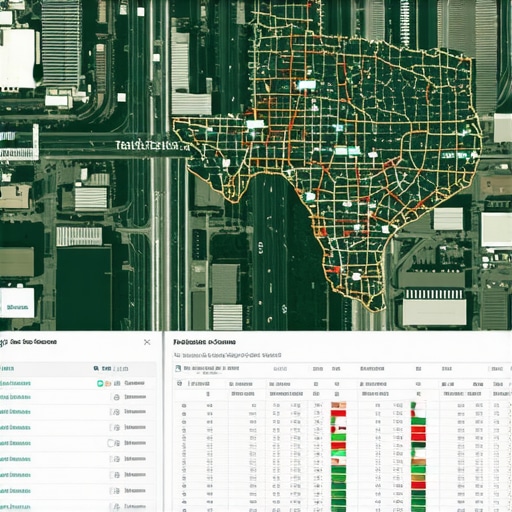
To fix this, agencies must utilize a sophisticated google maps rank tracker that provides a geo-grid visualization. Instead of a single number, a geo-grid shows a map of Fort Worth with ranking pins every half-mile. This allows the client to see exactly where their “Map Pack” dominance ends and where competitors start taking over. Seeing the “Proximity Trap” in action is often a wake-up call for business owners. It demonstrates why they need ongoing google business profile seo to expand their “circle of influence” across the DFW area. You can learn more about how to navigate this in our guide on the proximity trap hiding your shop from neighbors on Google Maps.
Without this granular data, you cannot effectively rank higher on google maps because you don’t actually know where you are losing. Transparency in reporting means showing the “red zones” on the map just as clearly as the “green zones.”
3 Crucial Lead Data Points Missing from Standard Texas SEO Reports
If we want to provide reports that Texas clients actually value, we have to track the metrics that indicate “intent to buy.” Here are three crucial data points that are almost always missing from standard white label reports:
1. Call Attribution vs. Total Clicks
Most reports lump all “clicks” together. But for a service-area business like a plumber or a tow truck operator, a click to the website is a secondary action. The primary action is the “Click to Call.” Your reports should distinguish between these two. Furthermore, sophisticated reporting should track “Direct Calls” – calls made by people who saw the number on the Google Business Profile but didn’t click the button. Without call attribution, you are underreporting the success of your gmb ranking service by as much as 30-50%.
2. Hyper-Local Keyword Intent
Standard reports focus on high-volume keywords. While ranking for “Plumber” is a great ego boost, the real money in Texas is in hyper-local, high-intent keywords. A report that shows growth for “Emergency slab leak repair Fort Worth” or “Commercial roofing Arlington” is infinitely more valuable than one showing a climb for “plumbing tips.” You need to demonstrate that your google business profile optimization is capturing the specific searches that happen when a pipe bursts at 2:00 AM. This is often tied to the physical location of the business, which is why your business address matters more than keywords in Fort Worth in many local search scenarios.
3. Review Velocity & Sentiment Analysis
Most local seo software will tell you your total number of reviews and your average star rating. That’s basic. What’s missing is “Review Velocity” – the rate at which you are acquiring new reviews compared to your top three competitors. If your top competitor in the Map Pack is getting 10 reviews a month and you’re getting two, you are losing ground, even if your average rating is higher. Additionally, sentiment analysis – tracking the specific keywords customers use in reviews (e.g., “fast service,” “fair price,” “professional”) – provides proof that your local map pack seo is attracting the right kind of customer.
How to Future-Proof Your Reporting for 2026 and AI Search
The landscape of search is shifting beneath our feet. With the rise of Google’s Search Generative Experience (SGE) and AI Overviews, the way we define “visibility” must change. By 2026, local seo services will no longer be just about ranking in a list of three; it will be about being the “Recommended” answer by an AI agent.
Future-proof reports need to move beyond traditional backlinks and start showing “Brand Mentions” and “AI Citations.” When an AI summarizes the best lawyers in Dallas, it pulls data from local news sites, niche directories, and social media sentiment. If your white label report doesn’t account for these “entity-based” signals, it’s already obsolete.
We are moving toward a world where “Zero-Click Searches” are the norm. This means a user gets all the information they need – phone number, hours, and reputation – directly from the search results without ever clicking through to a website. In this environment, google business profile leads are the only currency that matters. Your reporting must adapt to show how your profile is winning the “Zero-Click” battle by providing comprehensive, AI-friendly data that Google can easily parse and recommend.
The Texas Agency’s Guide to Choosing Better White Label Partners
For marketing agencies in the DFW area, scaling can be a nightmare. You want to grow, but you don’t want to sacrifice the quality of the results you provide to your local clients. This is where choosing the right partner becomes a make-or-break decision. You need to know the secret to scaling your Texas agency without hiring a full-time SEO team, and that secret lies in transparency and “Proof of Work.”
When vetting a local seo agency or a software provider, look for the following “Receipts”:
- Custom Branding: Does the local seo software allow you to present the data under your own brand, building trust with the client?
- Manual vs. Automated Balance: Purely automated reports are usually full of fluff. Does the provider offer manual insights or the ability to add executive summaries?
- Conversion Tracking: Can they integrate with tools that track actual phone calls and form submissions, rather than just “estimated” lead data?
According to data from Fortunly, 99.9% of American businesses are small businesses. In Texas, these owners are notoriously “no-nonsense.” They don’t have time for a 50-page report that requires a degree in data science to understand. They want to see that you are actively working to stop nearby competitors from stealing your Fort Worth map traffic. They want to see the “Receipts” of your labor – the posts made, the photos optimized, and the citations cleaned up.
If you are using generic local seo tools that just spit out a monthly PDF, you aren’t providing a service; you’re providing a distraction. A true partner provides a google maps rank tracker that shows the battle for the suburbs, from Keller to Mansfield, and everywhere in between.
Conclusion: Moving Beyond the PDF
At the end of the day, the best report isn’t a PDF; it’s a ringing phone and a full schedule. If your white label local SEO reports are still focusing on impressions and broad keyword rankings, you are missing the lead data that Texas clients actually care about. They want to see proximity-based growth, call attribution, and a clear path to ROI.
It’s time to stop settling for generic, automated fluff and start demanding reporting that reflects the reality of the Texas market. Whether you are an agency looking to scale or a business owner looking for results, the focus must remain on lead generation and revenue. Stop hiding behind “visibility” and start showing the “So What?”
Are you ready to see what’s actually happening with your local search presence? Contact me today for a comprehensive google business profile audit. We’ll skip the vanity metrics and dive deep into the data that actually puts money in your pocket. Let’s build a strategy that focuses on revenue, not just rankings.