How to use map data to spot a ranking drop before the phone stops ringing
How to Use Map Data to Spot a Ranking Drop Before the Phone Stops Ringing
In the world of local business, there is a specific type of silence that is deafening. It’s the silence of a phone that isn’t ringing, the chime of a lead notification that hasn’t sounded in days, and the empty space in a digital calendar where appointments used to be. For most small business owners – be they plumbers in Fort Worth, roofers in Dallas, or dentists in Austin – this silence is the first indication that something is wrong with their digital presence. But here is the brutal truth: by the time you notice the silence, the damage has been done for weeks.
This is what I call the “Silent Killer” of local leads. In my years as a Senior SEO Specialist, I have seen it time and again. A business owner calls in a panic because their lead flow has dried up. When we look at the data, we realize they haven’t been visible on Google Maps for 7 to 14 days. They were invisible, and they didn’t even know it because their rank tracker told them they were “number one” for their primary keyword.
The problem is that traditional reporting is reactive. If you want to survive the hyper-competitive landscape of 2026, you need to transition to a proactive stance. You need to use map data – specifically heatmaps, grid trackers, and deep-dive insights – as an early warning system. Understanding why your Google Business Profile stopped showing up for local customers before the leads vanish is the difference between a minor adjustment and a total business crisis.
Understanding the 2026 Local Ranking Factors
To spot a drop, you first have to understand what keeps you at the top. As we navigate 2026, the local algorithm has evolved beyond the simple “NAP” (Name, Address, Phone) consistency of yesteryear. While the three core pillars remains Relevance, Distance, and Prominence, the way Google weights these factors has been fundamentally altered by AI-driven search intent and the integration of the Gemini model into local discovery.
In a recent IMPIOUS 2026 study regarding Spearman rank correlation, researchers found that many traditional signals now have a ρ (rho) value approaching zero. In statistical terms, this means these signals no longer predict rankings monotonically. For example, simply having your city name in your title tag no longer guarantees a boost if your google business profile seo isn’t backed by high-intent user behavior data and localized entity signals.
Google’s AI now prioritizes “Real-World Authority.” It looks at how often people are actually visiting your location, how long they stay, and the sentiment of the photos they upload. If your prominence score begins to dip because your competitors are generating more “real-world” signals, your map pin will start to recede. Spotting this shift in the data allows you to pivot your strategy before your visibility hits the floor.
The Early Warning System: Heatmaps vs. Traditional Reports
Why do standard rank trackers fail local businesses? Because they provide a “single-point” perspective. A traditional tracker might check your ranking from a single IP address or a single zip code centroid. It tells you that you are #1, and you feel safe. But local SEO is granular. You might rank #1 at your front door, but drop to #10 just two blocks away.
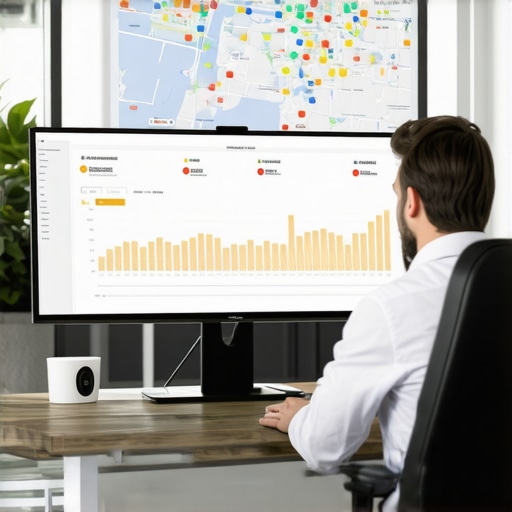
This is known as the “Proximity Glitch.” It occurs when Google’s algorithm tightens the radius of who it shows in the Map Pack for a specific query. If you aren’t using a google maps rank tracker that utilizes a grid-based heatmap, you are flying blind. A heatmap shows you a visual representation of your rankings across a 5×5, 7×7, or 13×13 grid over your service area. If you see the “green” (top 3 rankings) shrinking toward the center of your pin, that is your early warning sign.
When you monitor these local seo tools weekly, you can catch the “shrinkage” before it hits your core service area. If you notice that your shop’s mobile map ranking changes every few blocks in Fort Worth, it indicates that your proximity authority is weakening. By catching this early, you can deploy hyper-local content or localized citations to push that radius back out before the phone stops ringing.
Step-by-Step: Diagnosing a Drop Before the “Silence”
If you suspect a drop – or if you simply want to be proactive – follow this three-step diagnostic process to ensure your visibility remains intact.
1. Confirm and Quantify with GBP Insights
Don’t just look at “Impressions.” Impressions can be misleading; you might be showing up for irrelevant searches. Instead, look at the ratio of “Interactions” (calls, direction requests, website clicks) to “Impressions.” If your impressions stay the same but your interactions drop, it means you are likely still in the Map Pack, but your “snippet” (the information displayed) is no longer enticing, or you’ve been pushed to the #3 spot from the #1 spot. AI-driven summaries in 2026 often favor the #1 result significantly more than in previous years.
2. Classify the Drop
Is the decline gradual or sudden? A gradual decline usually indicates competitive pressure. Your neighbors are doing better SEO, getting more reviews, or updating their profiles more frequently. A sudden drop, however, indicates a “Hard Filter” or a potential suspension. Use a google business profile audit tool to check for any “hidden” violations, such as a change in your service area settings that Google didn’t like, or a sudden influx of filtered reviews.
3. Check Local Accuracy and Data Integrity
Inaccuracies in your business data are the primary cause of sudden ranking drops. We recently saw a case study with Green Oaks, a local service provider that tripled their leads in 90 days simply by fixing data discrepancies. They had three different versions of their phone number across the web. To Google’s AI, this looks like a lack of “Trustworthiness.” You must identify the messy data error keeping your Texas business off the first page before it compounds into a total loss of rankings.
The “Proximity Filter” and Competitor Sabotage
Even if you do everything right, external factors can tank your rankings. One of the most common issues in 2026 is the “Proximity Filter” being manipulated by competitor sabotage. Competitors may use “keyword stuffing” in their business names or create “fake locations” (ghost offices) to surround your business and push you out of the local grid.
Using advanced google maps ranking service features, you can monitor the “neighborhood” of your map pin. If a new business suddenly appears with a keyword-rich name like “Best Plumber Fort Worth Emergency Services” and they have zero real-world history, they are likely a spam listing. If you don’t report these or counter them with your own prominence signals, they will eat your leads.
You need to know how to stop nearby competitors from stealing your Fort Worth map traffic. This involves more than just reporting spam; it involves strengthening your own “Entity” so that Google views you as the “anchor” of that category in your city, making you harder to filter out.
Recovery Tactics for 2026
If you’ve spotted a drop, don’t panic. Recovery is possible if you act within the first 14 days. In 2026, the most effective recovery tactics involve a combination of geo-tagged content and “Review Velocity.”
- The Core 30 Method: This is a strategy where you focus on the 30 most relevant local entities (parks, landmarks, local government buildings) near your business and create content that connects your services to those locations. This reinforces your “Distance” and “Relevance” pillars.
- Geo-Tagged Media: Uploading photos to your GBP that contain EXIF data (GPS coordinates) of your actual job sites helps Google verify your service area.
- Review Velocity: It’s not just about the total number of reviews; it’s about how fast you are getting them compared to your competitors.
Consider the case of Accent Awnings. By managing these signals effectively and focusing on hyper-local authority rather than just broad keywords, they saw a 1024% return on their SEO investment. These are the 7 Texas Ranking Moves That Work Better Than Buying Backlinks. They focus on real-world signals that the AI can’t ignore.
Conclusion: Data is Your Only Shield
The days of “setting and forgetting” your Google Business Profile are over. In 2026, the local algorithm moves too fast, and the competition is too savvy. If you wait for the phone to stop ringing to check your rankings, you’ve already lost the battle. Data – specifically map-based grid data – is the only way to stay ahead of the silence.
Don’t let your business become a victim of the “Silent Killer.” Perform a comprehensive audit of your visibility today. Whether you use a google business profile optimization tool yourself or hire a professional SEO Viper Tools expert to manage your map presence, the goal is the same: stay visible, stay relevant, and keep the phone ringing.